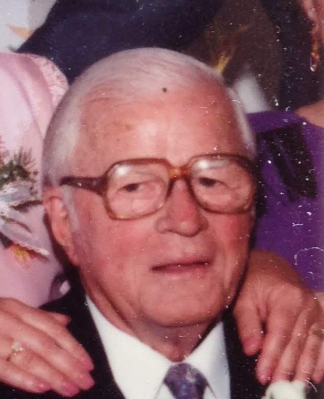
From Woodstock to Grand Falls
John’s story connects two New Brunswick communities: Woodstock and Grand Falls. Brian Kennedy’s published family tree records his birth in Woodstock on 16 December 1909, names his parents as Robert E. Hughes and Edith Maud Flynn, and places his death in Grand Falls in 1998. These are useful biographical details from a compiled genealogy; the original birth and death records remain to be checked for this website. [1]
The same compilation records his marriage to Martha, also written Marthe, Lévesque at Grand Falls on 18 September 1930. Martha’s obituary excerpt independently identifies her as John Hughes’s widow and a resident of Grand Falls. Behind the historical storyteller was a family life, and it is that connection which gives this archive its name: Grampy Hughes Memories. [1] [2]
A boy of fourteen, remembering a working world
The clearest account of John’s early life here comes from John himself. In Six Months at Hard Labour, he recalls losing interest in school and going to a logging camp at fourteen. The title sounds severe, but his opening describes the experience with excited anticipation. He remembers the L. P. Fisher Library, a kitchen table lit by a kerosene lamp, and the journey into a working world of cooks, lumber camps and railway travel. [Manuscript]
These details give the story its character. Places are attached to people, and work is remembered through the everyday business of getting there, eating, helping out and returning home. His account preserves an individual memory of life in the woods. It can be read as autobiography, while its handwritten pages also give later generations a tangible connection to their grandfather.
Giving local history a voice
The family identifies John as the presenter in Grand Falls Past. One surviving online segment is titled Grand Falls Past – CPR Locomotive 508. It provides a route back to his original television work, distinct from the newly recreated narration of his written story. The programme’s broadcaster, production credits, exact dates and complete episode list still need documentation. [3]
The subject connects directly to the landscape of Grand Falls. Eric Ouellette’s Locomotive 508 research site describes the railway bridge collapse of 21 June 1900, when the locomotive went into the Saint John River. That later research supplies context for the episode; it is a separate source, rather than proof of every statement in the older programme. [4]
The museum and the community’s memory
The Grand Falls Museum and the Société historique de Grand-Sault / Grand Falls Historical Society form part of the town’s continuing heritage community. The municipality lists the society by both names. Association Heritage New Brunswick describes the museum as a volunteer-run collection exploring local life and businesses; Anne Côté’s research guide also describes its archives and genealogical resources. [5] [6] [7]
A particularly interesting trace appears in the acknowledgements to the National Park Service publication Acadian Culture in Maine, hosted by the University of Maine at Fort Kent: it thanks “J. Hughes, Grand Falls Historical Museum.” This may refer to John, but the initials alone do not establish that identification or his position. It is a lead worth following in the museum’s records. [8]
A collection that lets us meet him again
His original manuscript and surviving programme give this biography its strongest personal foundation. Preserving them together lets a reader move from the man’s photograph to his handwriting, and from a written memory to his own recorded voice. As more documents and episodes become available, his life can be told in greater detail without losing that close connection to the sources.