This narrated edition uses an AI recreation of John H. Hughes’s voice, created from archival recordings. It is not an original historical recording.
Read along
Originals & sources“Six months at hard labour.” A sentence of chilling words for any man. But to be given to a boy of fourteen years! But I accepted it with excited anticipation. My crime? Loss of interest in school.
School had become a bore. Lessons had become rote exercises. My real classroom had become the L P Fisher Library, the foundry, sawmills, garage, pumping station, roundhouse. I could read half the night at the old kitchen table at home by kerosene lamp. The favorite position was kneeling on a chair with elbows on the table. Ma would complain about burnt-up wicks, for as the oil ran out, the wick would be gradually turned up to finish a chapter. The old lamp was also a good hand warmer after the fire had gone out.
There was no such a thing as a drop-out then. This term came into use only recently, so I just quit school. I was quite a husky lad for my age and could handle any two boys my own age.
So, if I didn't want to go to school, my parents said I should go to work.
My father was going in to cook for Harry and Bill Rogers at their lumber camp back of Scofield Siding on the C N R. They were cutting for Flemming and Gibson mill at Welch Siding, and I was to be a cookie. On the first of October, Pa had gone on ahead to Juniper to gather up supplies, and I followed in a couple of days. The C P R took me from Woodstock to Bristol, where the stage ran into Juniper with a stop at Glassville for lunch. In the summer, the stage was a buckboard with leather curtains, and in winter, a sled with seats hauled by a pair of lively horses. But I went in with the buckboard. The road was muddy, rutted and rough all the way. The driver was a character with long moustaches. Every so often, he would belt out a song so loud I am sure you would know the stage was coming long before it even came into sight.
When I arrived in Juniper, my father was not there, so I went to the boarding house and had supper. The only thing I remember of this meal was the bread was sour. After supper, the men all gathered in the big room off the dining room and sat on benches around the camp stove. This was in the old boarding house. They were just building the new one. Gradually, the men drifted off to bed, and there were only a couple or so left. One asked if I had a place to sleep, and I told him, “Not yet.” He said I better not sleep up in the bunk room, as it was crummy, so I decided to stay where I was. I recall vividly trying to sleep on a four-foot by one-foot bench, and how I shivered when the fire in the old camp stove went out. I was glad when the men began to come in and the fire was made up.
My father showed up. I guess he had not really expected me to arrive and had been at a small bunkhouse with some friends.
The sleds were loaded up with supplies, and we started on the tote road. “Sleds in October?” Yes, there was at least a foot on the ground. It was a rough ride in, but we made it in fair time. The campsite was there, but no camp, so the men got busy and put up a frame and roof. This was to be a board-and-tar-paper building. There was no time that day to put on the sides, but a long upper and lower bunk was built on one side, board tables and benches set in the remaining space, and the cook's stove at one end. The advance crew was about fifteen men, to get the camp ready for the main crew of eighty men to come in later. So things were very busy for the next week or so. The cook shack was boards and tar paper, with a small addition on one end for the boss and clerk. The main bunkhouse was of logs, with bunks along each side and a large camp stove in the centre, with a rack above and under the large ventilator skylight, the only window. Washing facilities were at the end near the door and consisted of two wash basins, two roller towels and a pork barrel for cold water. Shaving, if any, was done on Sundays with water heated on the camp stove.
I remember one brave lad borrowing the wash tub from the cookhouse on a sunny Sunday and taking a bath outdoors.
The hovel for the horses was made of logs. There was another small tar-paper shack for the teamsters and saw filer. The teamsters slept in a separate shack, as they had to get up before the other men to feed the horses.
More supplies came in along with the main crew. The cookhouse crew was the cook, second cook, bull cook and cookie, me.
The first day the main crew came in, about eighty men, it was found someone made a mistake and had not sent in any forks. So I was appointed to walk into Welsh Siding, about ten miles, for a supply of forks. I was given a loaded rifle, as there was danger of wildcats, but I made the trip without incident.
Each man was supplied with two gray wool blankets. There was no mattress. You were given a supply of hay, then you put one blanket over the hay and covered yourself with the other. You rolled up your coat for a pillow. I remember one old timer brought his own pillow. Old men were called “Uncle.” Work for the crew was six days a week, from dark to dark. The cookhouse crew worked seven days.
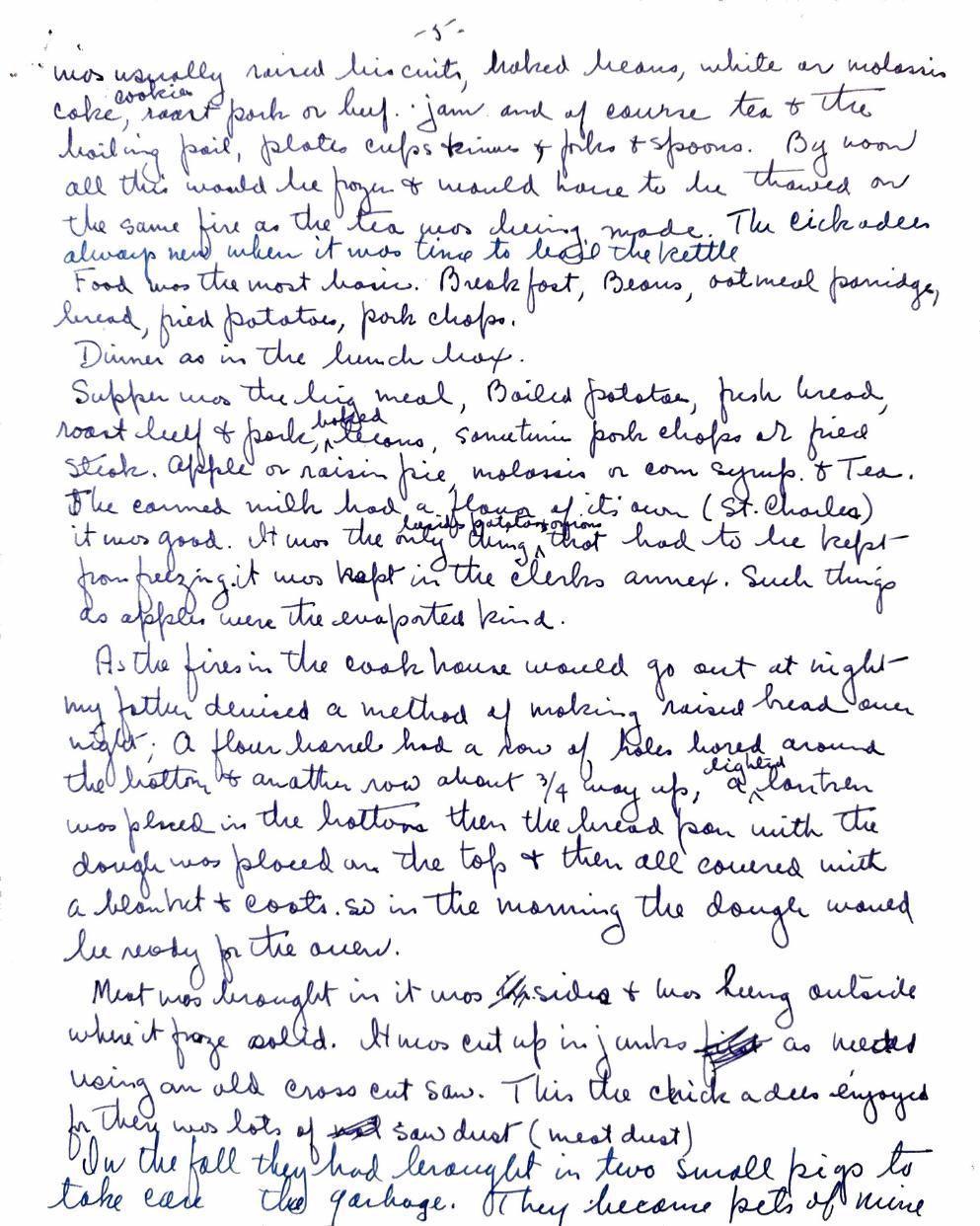
We were up at five in the morning. The second cook was up at four thirty to start the cook stove. Breakfast was at six in the morning. While the men were eating, the noon lunch was made up and placed in a long wooden box with rope handles. This lunch was usually round biscuit, baked beans, white or molasses cake, cookies, roast pork or beef, jam and of course tea, along with the boiling pail, plates, cups, knives, forks and spoons. By noon, all this would be frozen and would have to be thawed on the same fire as the tea was being made. The chickadees always knew when it was time to boil the kettle.
Food was the most basic. Breakfast: beans, oatmeal porridge, bread, fried potatoes, pork chops.
Dinner, as in the lunch box.
Supper was the big meal: boiled potatoes, fresh bread, roast beef and pork, baked beans, sometimes pork chops or fried steak. Apple or raisin pie, molasses or corn syrup, and tea. The canned milk, Saint Charles, had a flavor of its own. It was good. It was the only thing besides potatoes and onions that had to be kept from freezing. It was kept in the clerk's annex. Such things as apples were the evaporated kind.
As the fires in the cookhouse would go out at night, my father devised a method of making raised bread overnight. A flour barrel had a row of holes bored around the bottom and another row about three-quarters of the way up. A lantern was placed in the bottom, then the bread pan with the dough was placed on the top, and then all covered with a blanket and coats. So, in the morning, the dough would be ready for the oven.
Meat was brought in. It was in sides and was hung outside, where it froze solid. It was cut up in junks as needed, using an old crosscut saw. This the chickadees enjoyed, for there was lots of sawdust, meat dust.
In the fall, they had brought in two small pigs to take care of the garbage. They became pets of mine.
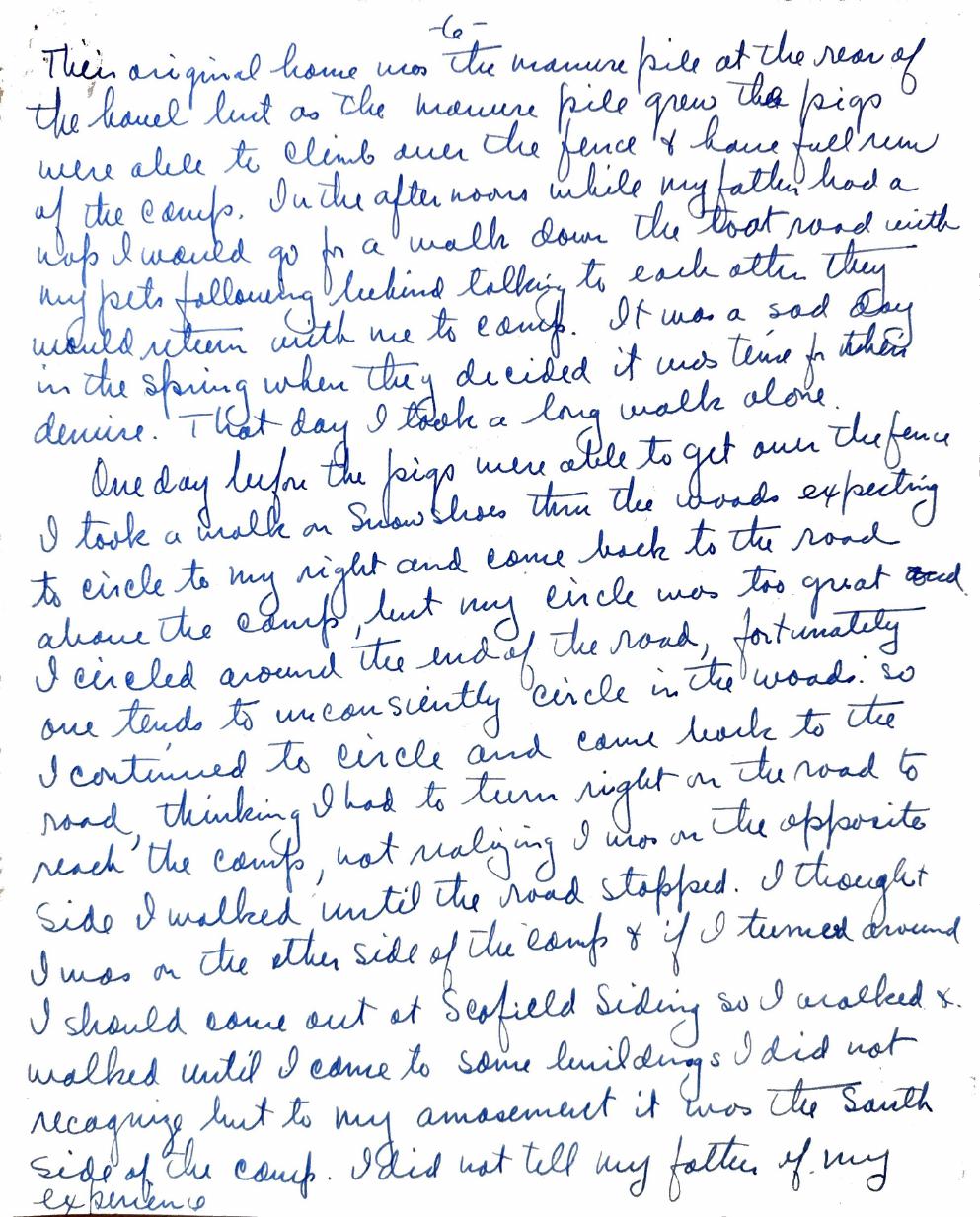
Their original home was the manure pile at the rear of the hovel, but as the manure pile grew, the pigs were able to climb over the fence and have full run of the camp. In the afternoons, while my father had a nap, I would go for a walk down the tote road with my pets following behind, talking to each other. They would return with me to camp. It was a sad day in the spring when they decided it was time for their demise. That day I took a long walk alone.
One day, before the pigs were able to get over the fence, I took a walk on snowshoes through the woods, expecting to circle to my right and come back to the road above the camp. But my circle was too great, and I circled around the end of the road. Fortunately, one tends to unconsciously circle in the woods. So I continued to circle and came back to the road, thinking I had to turn right on the road to reach the camp. Not realizing I was on the opposite side, I walked until the road stopped. I thought I was on the other side of the camp, and if I turned around, I should come out at Scofield Siding. So I walked and walked until I came to some buildings I did not recognize. But to my amazement, it was the south side of the camp. I did not tell my father of my experience.
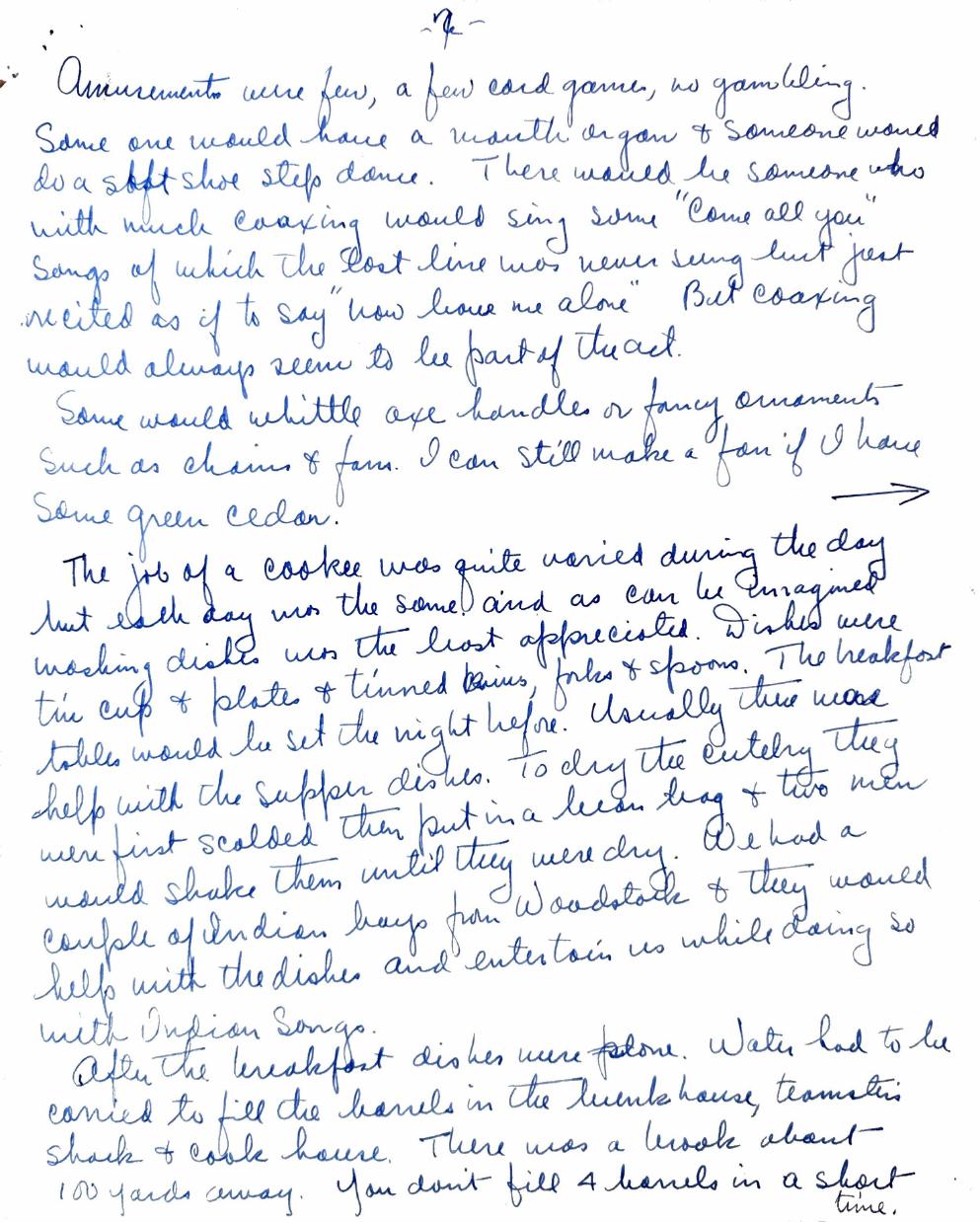
Amusements were few: a few card games, no gambling. Someone would have a mouth organ, and someone would do a soft-shoe step dance. There would be someone who, with much coaxing, would sing some “Come all you” songs, of which the last line was never sung but just recited as if to say, “Now leave me alone.” But coaxing would always seem to be part of the act.
Some would whittle axe handles or fancy ornaments such as chains and fans. I can still make a fan if I have some green cedar.
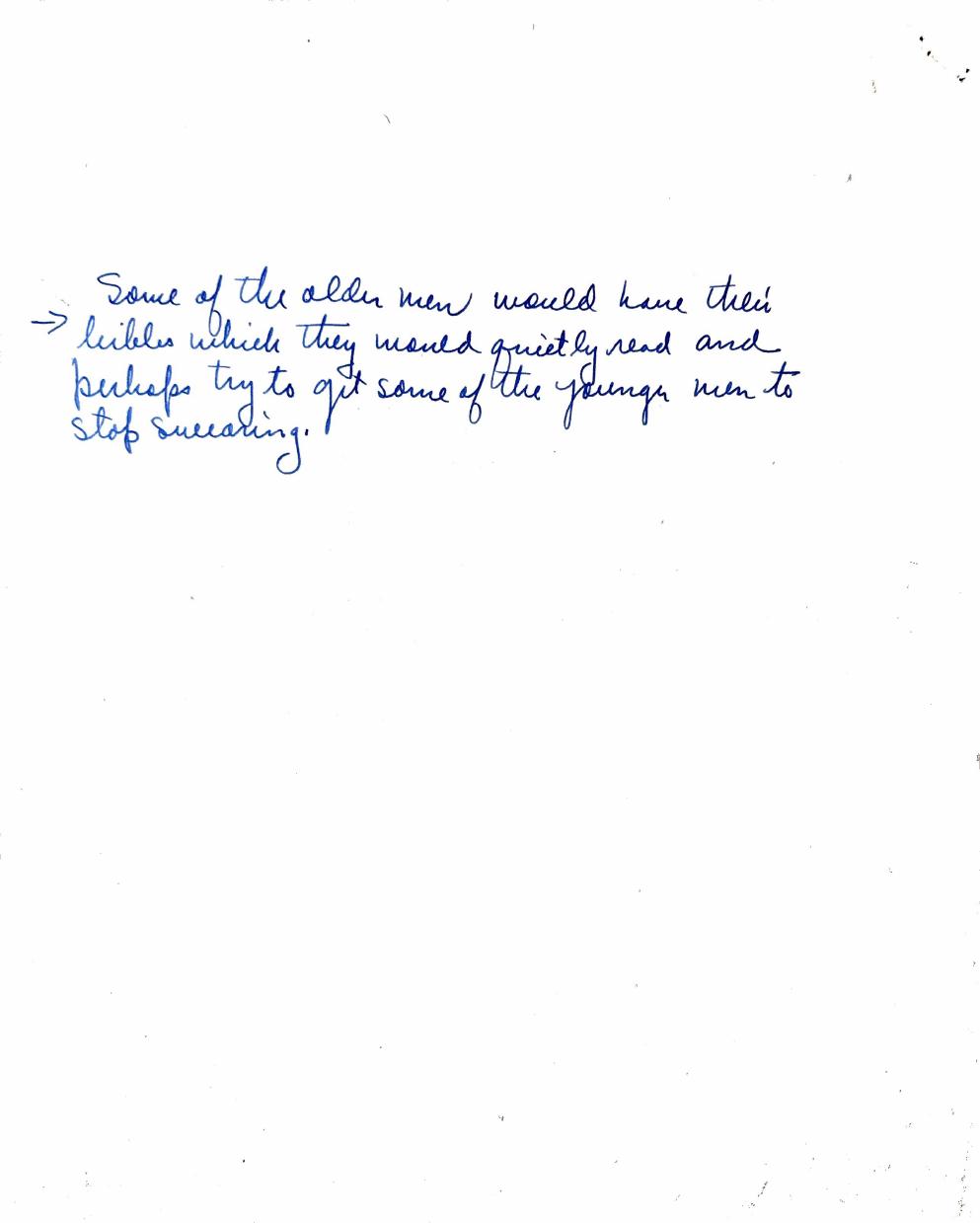
Some of the older men would have their Bibles, which they would quietly read, and perhaps try to get some of the younger men to stop swearing.
The job of a cookie was quite varied during the day, but each day was the same. And, as can be imagined, washing dishes was the least appreciated. Dishes were tin cups and plates, and tinned knives, forks and spoons. The breakfast tables would be set the night before. Usually, the cook would help with the supper dishes. To dry the cutlery, they were first scalded, then put in a clean bag, and two men would shake them until they were dry. We had a couple of Indian boys from Woodstock, and they would help with the dishes and entertain us while doing so with Indian songs.
After the breakfast dishes were done, water had to be carried to fill the barrels in the bunkhouse, teamsters' shack and cookhouse. There was a brook about a hundred yards away. You don't fill four barrels in a short time.
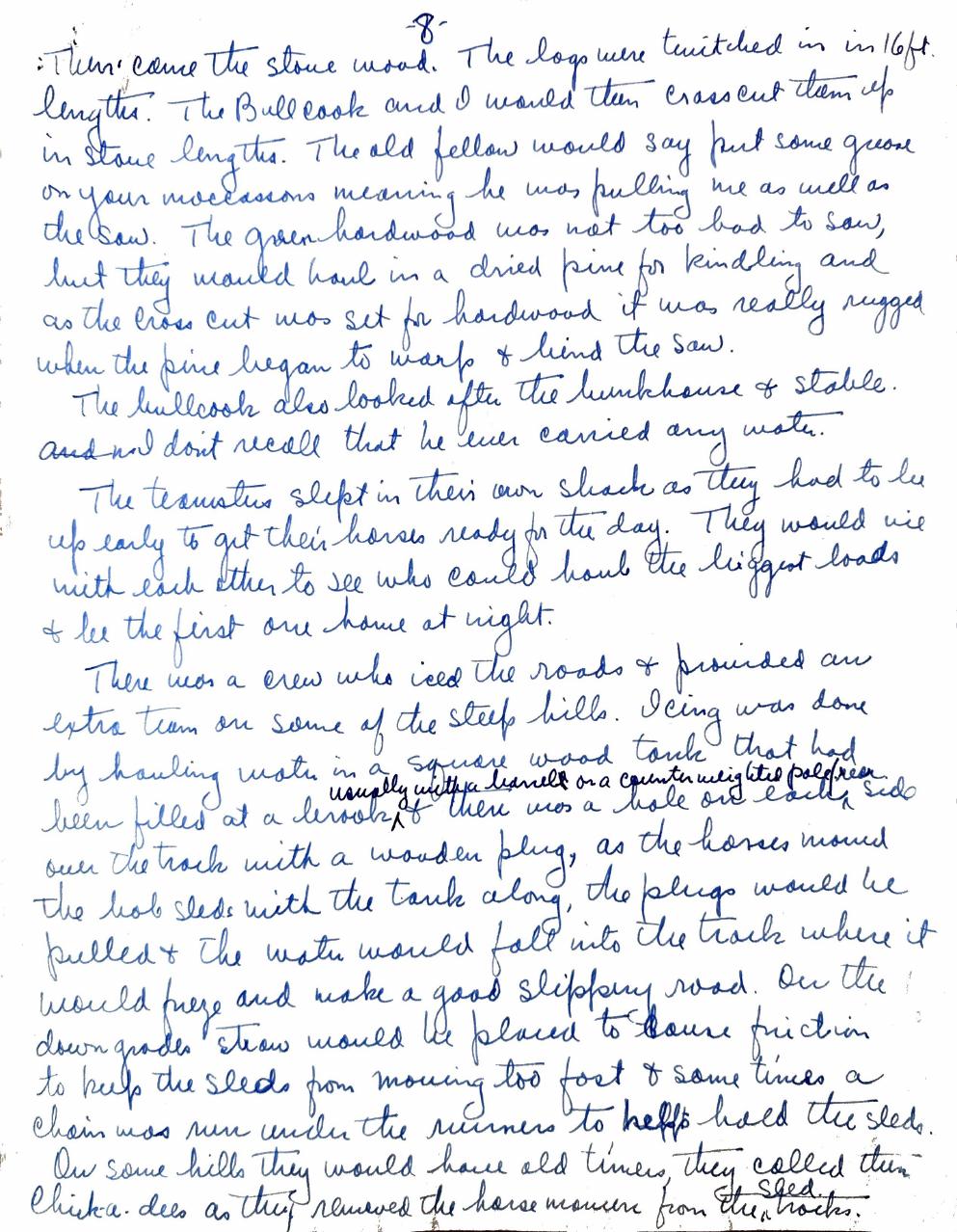
Then came the stove wood. The logs were twitched in, in sixteen-foot lengths. The bullcook and I would then crosscut them up in stove lengths. The old fellow would say, “Put some grease on your moccasins,” meaning he was pulling me as well as the saw. The green hardwood was not too bad to saw, but they would haul in a dried pine for kindling. And as the crosscut was set for hardwood, it was really rugged when the pine began to warp and bind the saw.
The bullcook also looked after the bunkhouse and stable. And no, I don't recall that he ever carried any water.
The teamsters slept in their own shack, as they had to be up early to get their horses ready for the day. They would vie with each other to see who could haul the biggest loads and be the first one home at night.
There was a crew who iced the roads and provided an extra team on some of the steep hills. Icing was done by hauling water in a square wood tank that had been filled at a brook, usually with a barrel on a counterweighted pole. There was a hole on each side over the track, with a wooden plug. As the horses moved the bob sleds with the tank along, the plugs would be pulled, and the water would fall into the track, where it would freeze and make a good slippery road. On the downgrades, straw would be placed to cause friction to keep the sleds from moving too fast, and sometimes a chain was run under the runners to help hold the sleds. On some hills they would have old timers. They called them chickadees, as they removed the horse manure from the sled tracks.
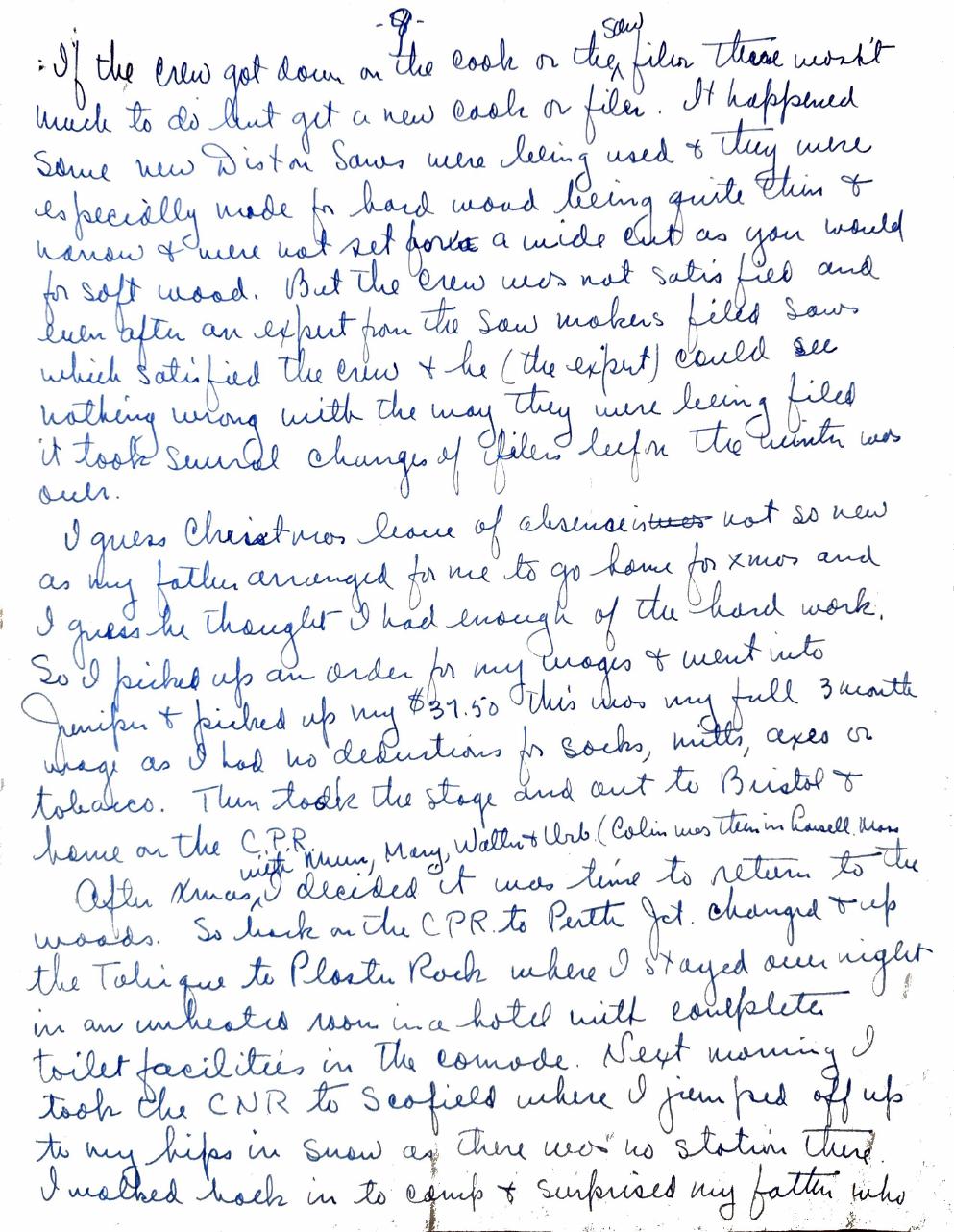
If the crew got down on the cook or saw filer, there wasn't much to do but get a new cook or filer. It happened some new Disston saws were being used, and they were especially made for hardwood, being quite thin and narrow, and were not set for quite as wide a cut as you would for softwood. But the crew was not satisfied. An expert from the saw makers filed saws, which satisfied the crew. He, the expert, could see nothing wrong with the way they were being filed. Even so, it took several changes of filers before the winter was over.
I guess Christmas leave of absence was not so new, as my father arranged for me to go home for Christmas. And I guess he thought I had enough of the hard work. So I picked up an order for my wages and went into Juniper and picked up my thirty-one dollars and fifty cents. This was my full three months' wage, as I had no deductions for socks, mitts, axes or tobacco. Then took the stage and out to Bristol and home on the C P R.
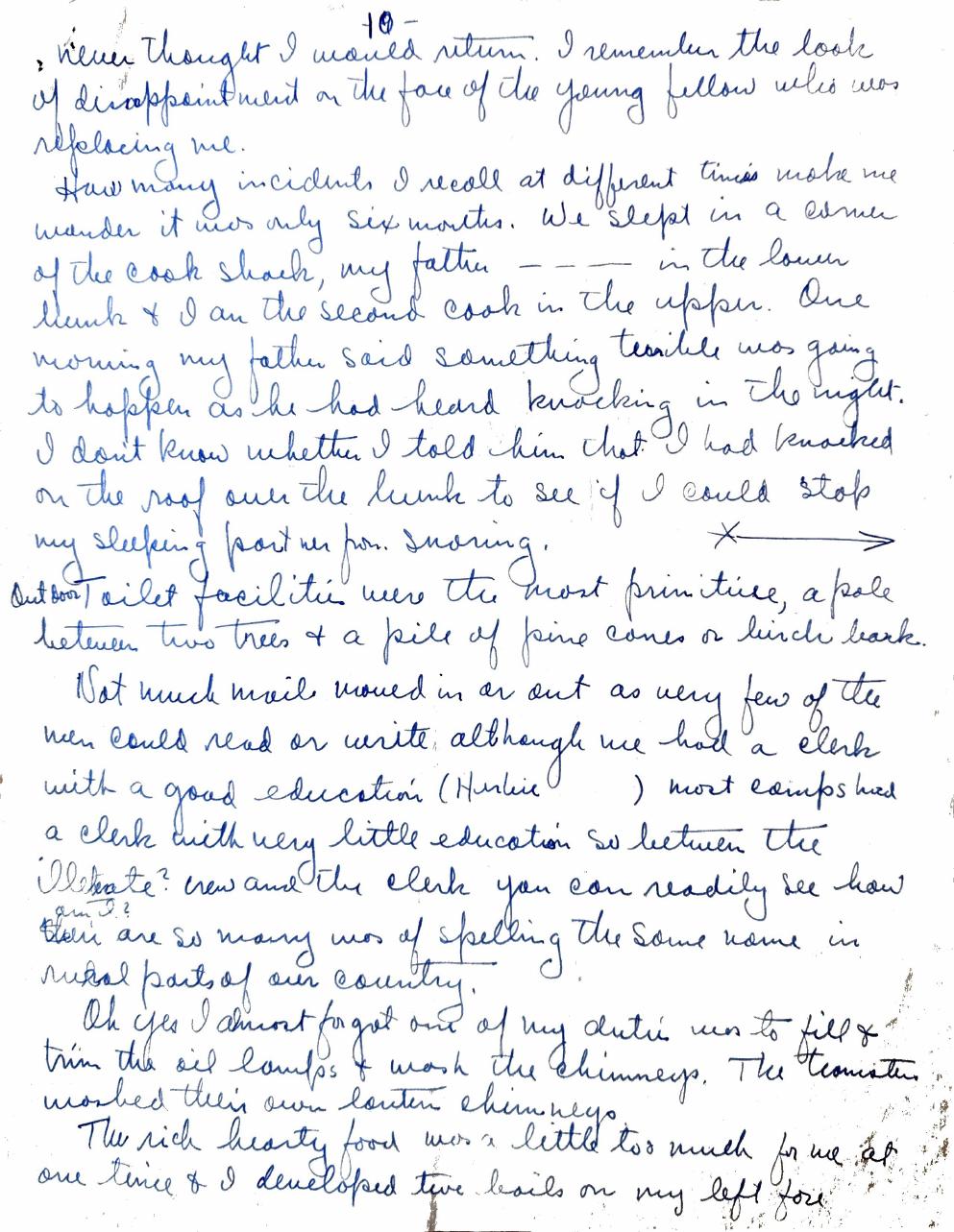
After Christmas with Mum, Mary, Walter and Urb, I decided it was time to return to the woods. Colin was then in Carroll, Maine. So back on the C P R to Perth Junction, where I changed trains to go up the Tobique to Plaster Rock. There I stayed overnight in an unheated room in a hotel, with complete toilet facilities in the commode. Next morning, I took the C N R to Scofield, where I jumped off up to my hips in snow, as there was no station there. I walked back into camp and surprised my father, who never thought I would return. I remember the look of disappointment on the face of the young fellow who was replacing me.
The many incidents I recall at different times make me wonder that it was only six months. We slept in a corner of the cook shack: my father in the lower bunk, and I and the second cook in the upper. One morning, my father said something terrible was going to happen, as he had heard knocking in the night. I don't know whether I told him that I had knocked on the roof over the bunk to see if I could stop my sleeping partner from snoring.
Outdoor toilet facilities were the most primitive: a pole between two trees and a pile of pine cones or birch bark.
Not much mail moved in or out, as very few of the men could read or write. Although we had a clerk with a good education, Hurlie, most camps had a clerk with very little education. So, between the illiterate men and the clerk, you can readily see how there are so many ways of spelling the same name in rural parts of our country.
Oh yes, I almost forgot. One of my duties was to fill and trim the oil lamps and wash the chimneys. The teamsters washed their own lantern chimneys.
The rich, hearty food was a little too much for me at one time, and I developed two boils on my left forearm.
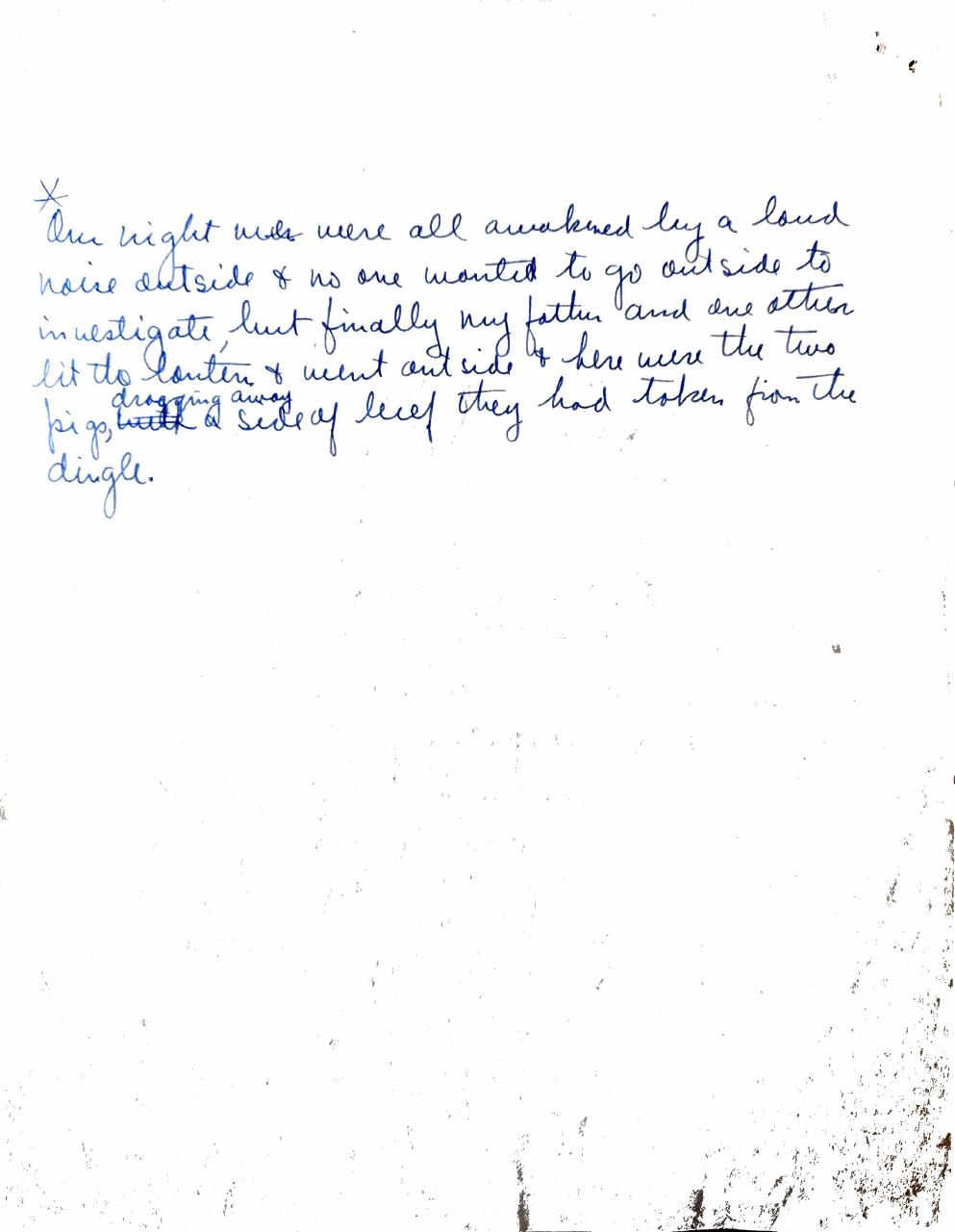
One night, we were all awakened by a loud noise outside, and no one wanted to go outside to investigate. But finally, my father and one other lit the lantern and went outside. And here were the two pigs, dragging away a side of beef they had taken from the dingle.
— John H. Hughes
Originals & sources
His handwritten pages and the materials preserved with this story.
The handwritten manuscript is the primary source. The typed version is a family-reviewed transcription. Narration is an AI recreation based on archival voice recordings and is not an original historical recording.
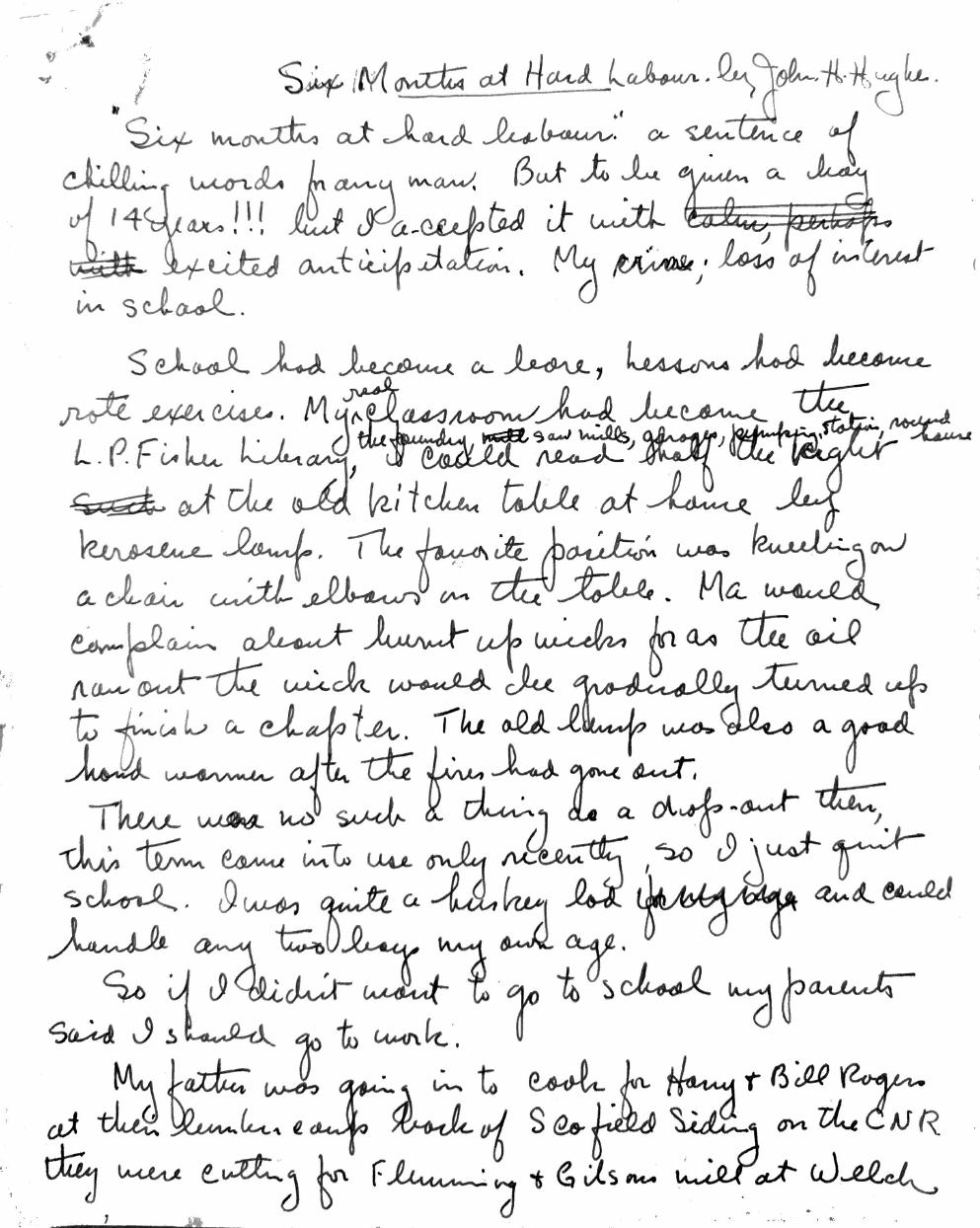
Original handwritten pages 12 pages · view and zoom
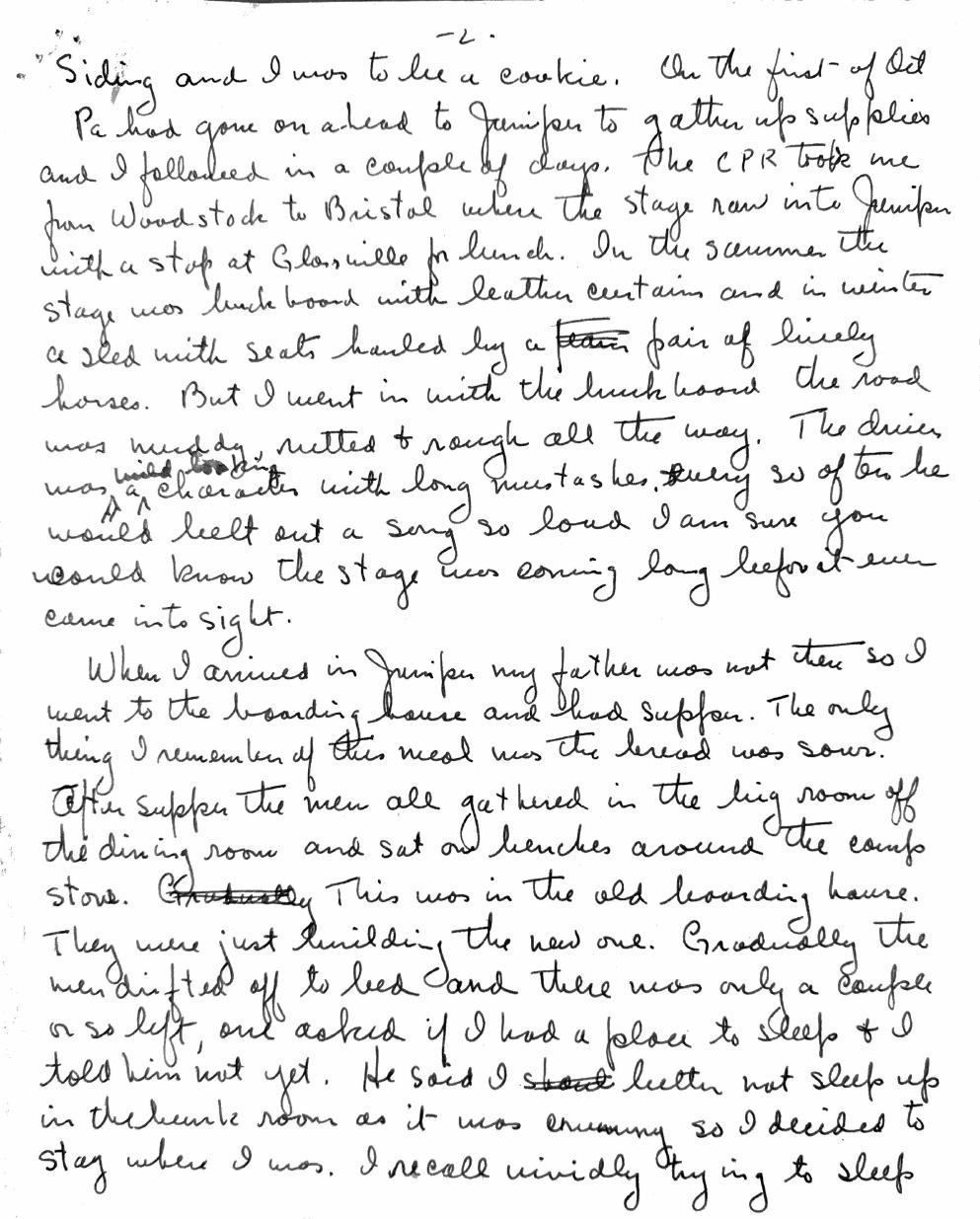
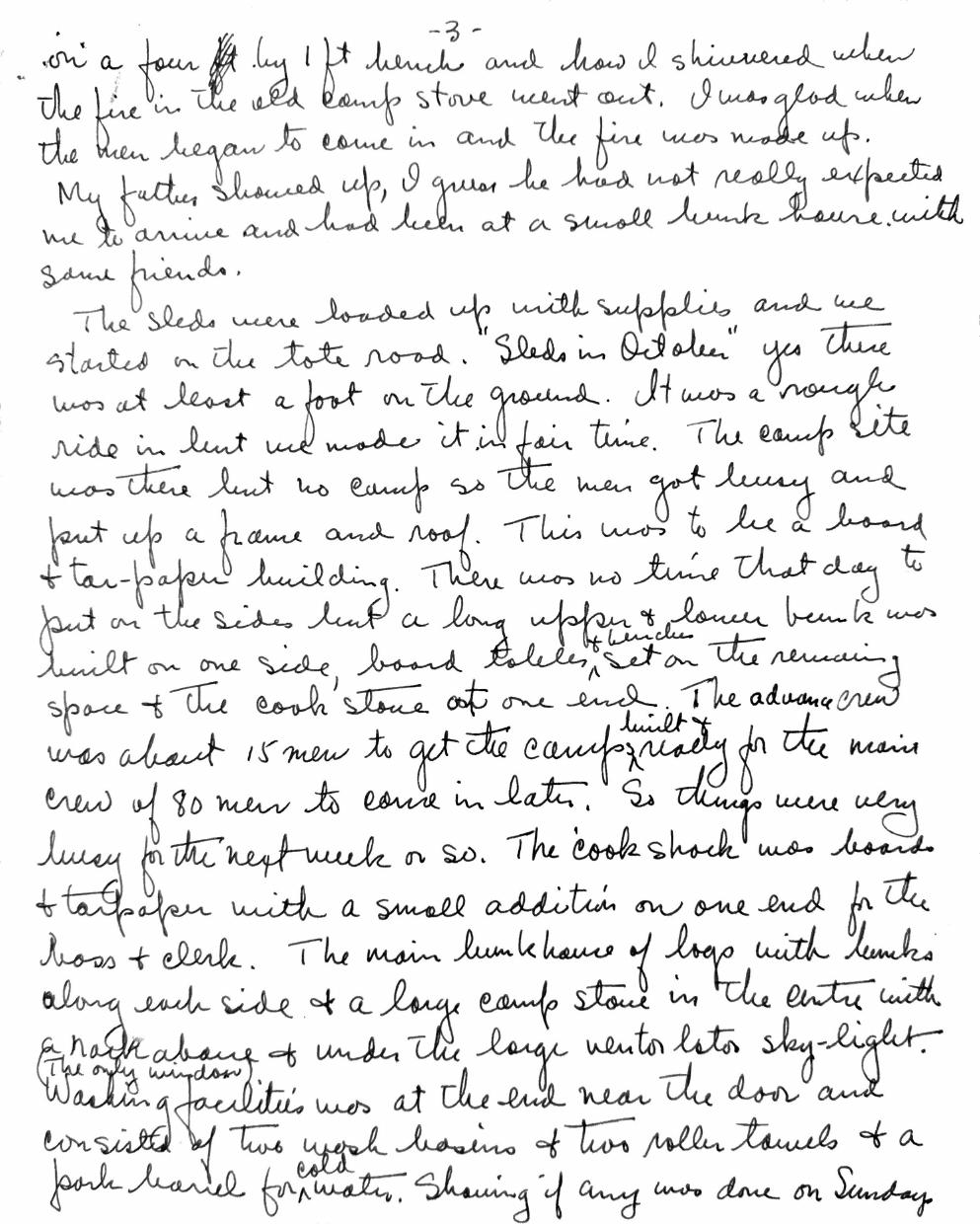
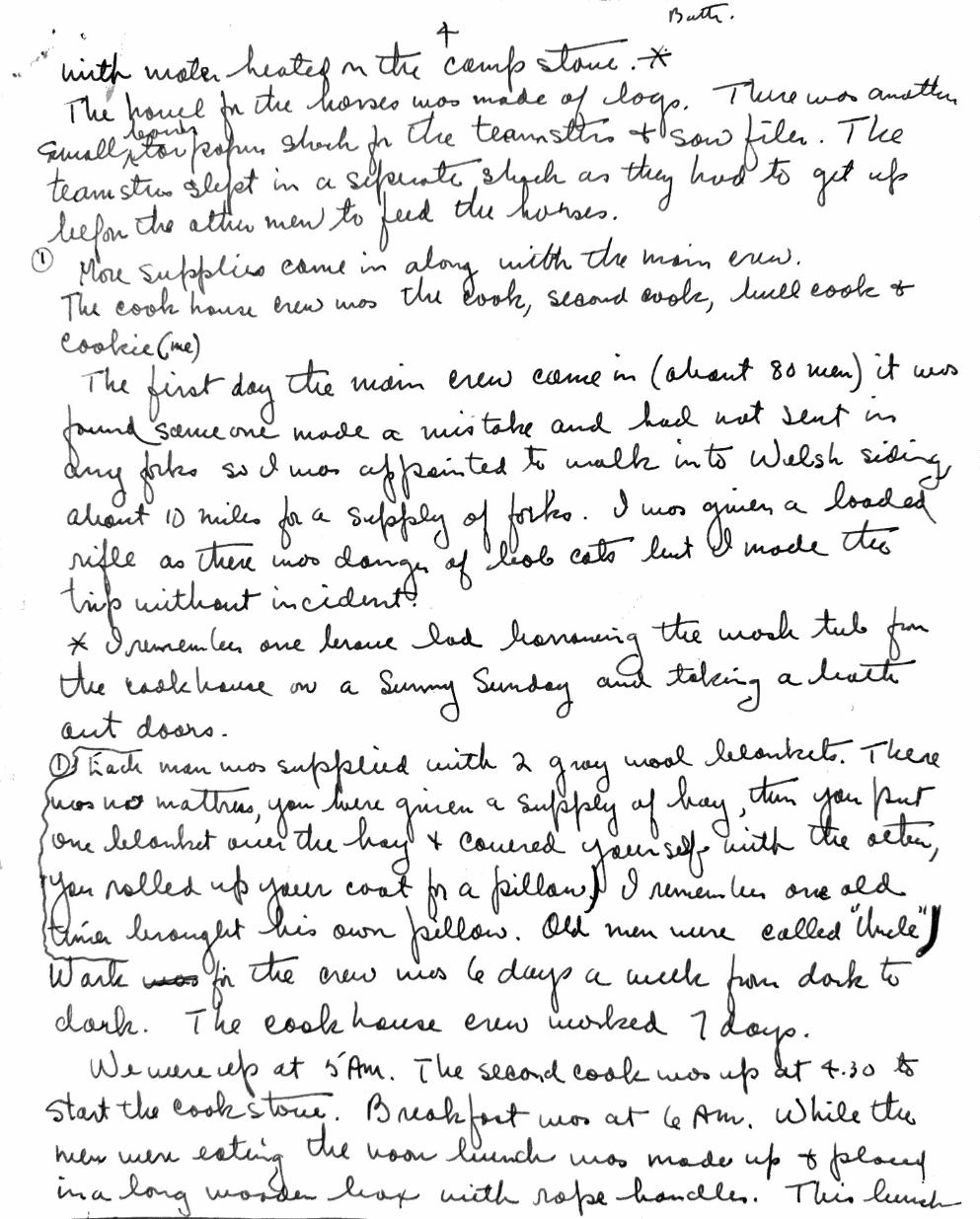
Original family-reviewed transcription Preserved source text
“Six months at hard labour.” a sentence of chilling words for any man. But to be given a boy of 14 years!!! but I accepted it with excited anticipation. My crime, loss of interest in school.
School had become a bore, lessons had become rote exercises. My real classroom had become the L.P. Fisher library, the foundry, saw mills, garage, pumping station, round house. I could read half the night at the old kitchen table at home by kerosene lamp. The favorite position was kneeling on a chair with elbows on the table. Ma would complain about burnt up wicks for as the oil ran out the wick would be gradually turned up to finish a chapter. The old lamp was also a good hand warmer after the fire had gone out.
There was no such a thing as a drop-out then, this term came into use only recently, so I just quit school. I was quite a husky lad for my age and could handle any two boys my own age.
So if I didn't want to go to school my parents said I should go to work.
My father was going in to cook for Harry & Bill Rogers at their lumber camp back of Scofield Siding on the C.N.R. they were cutting for Flemming & Gibson mill at Welch
Siding and I was to be a cookie. On the first of Oct Pa had gone on ahead to Juniper to gather up supplies and I followed in a couple of days. The C.P.R. took me from Woodstock to Bristol where the stage ran into Juniper with a stop at Glassville for lunch. In the summer the stage was a buck board with leather curtains and in winter a sled with seats hauled by a pair of lively horses. But I went in with the buck board the road was muddy, rutted & rough all the way. The driver was a character with long mustashes. Every so often he would belt out a song so loud I am sure you would know the stage was coming long before it even came into sight.
When I arrived in Juniper my father was not there so I went to the boarding house and had supper. The only thing I remember of this meal was the bread was sour. After supper the men all gathered in the big room off the dining room and sat on benches around the camp stove. This was in the old boarding house. They were just building the new one. Gradually the men drifted off to bed and there was only a couple or so left, and asked if I had a place to sleep & I told him not yet. He said I better not sleep up in the bunk room as it was crummy so I decided to stay where I was. I recall vividly trying to sleep
on a four ft by 1 ft bench and how I shivered when the fire in the old camp stove went out. I was glad when the men began to come in and the fire was made up.
My father showed up, I guess he had not really expected me to arrive and had been at a small bunk house with some friends.
The sleds were loaded up with supplies and we started on the tote road. “Sleds in October” yes there was at least a foot on the ground. It was a rough ride in but we made it in fair time. The camp site was there but no camp so the men got busy and put up a frame and roof. This was to be a board & tar-paper building. There was no time that day to put on the sides but a long upper & lower bunk was built on one side, board tables & benches set on the remaining space & the cook's stove at one end. The advance crew was about 15 men to get the camp ready for the main crew of 80 men to come in later. So things were very busy for the next week or so. The cook shack was boards & tar-paper with a small addition on one end for the boss & clerk. The main bunkhouse of logs with bunks along each side & a large camp stove in the centre with a rack above & under the large ventilator sky-light. (The only window.) Washing facilities was at the end near the door and consisted of two wash basins & two roller towels & a pork barrel for cold water. Shaving if any was done on Sundays
with water heated on the camp stove.
I remember one brave lad borrowing the wash tub from the cook house on a Sunny Sunday and taking a bath out doors.
The hovel for the horses was made of logs. There was another small tar paper shack for the teamsters & saw filer. The teamsters slept in a separate shack as they had to get up before the other men to feed the horses.
More supplies came in along with the main crew. The cook house crew was the cook, second cook, bull cook & cookie (me).
The first day the main crew came in (about 80 men) it was found someone made a mistake and had not sent in any forks so I was appointed to walk into Welsh siding about 10 miles for a supply of forks. I was given a loaded rifle as there was danger of wild cats but I made the trip without incident.
Each man was supplied with 2 gray wool blankets. There was no mattress, you were given a supply of hay, then you put one blanket over the hay & covered yourself with the other, you rolled up your coat for a pillow. I remember one old timer brought his own pillow. Old men were called “Uncle”. Work for the crew was 6 days a week from dark to dark. The cook house crew worked 7 days.
We were up at 5 AM. The second cook was up at 4:30 to start the cook stove. Breakfast was at 6 AM. While the men were eating the noon lunch was made up & placed in a long wooden box with rope handles. This lunch
was usually round biscuit, baked beans, white or molasses cake, cookies, roast pork or beef, jam and of course tea & the boiling pail, plates cups knives & forks & spoons. By noon all this would be frozen & would have to be thawed on the same fire as the tea was being made. The chickadees always knew when it was time to boil the kettle.
Food was the most basic. Breakfast, Beans, oatmeal porridge, bread, fried potatoes, pork chops.
Dinner as in the lunch box.
Supper was the big meal, Boiled potatoes, fresh bread, roast beef & pork, baked beans, sometime pork chops or fried steak. Apple or raisin pie, molasses or corn syrup. & Tea. The canned milk had a flavor of its own (St. Charles) it was good. It was the only thing besides potatoes & onions that had to be kept from freezing it was kept in the clerks annex. Such things as apples were the evaporated kind.
As the fires in the cook house would go out at night my father devised a method of making raised bread over night. A flour barrel had a row of holes bored around the bottom & another row about 3/4 way up, a lantern was placed in the bottom then the bread pan with the dough was placed on the top & then all covered with a blanket & coats. So in the morning the dough would be ready for the oven.
Meat was brought in it was in sides & was hung outside where it froze solid. It was cut up in junks as needed using an old cross cut saw. This the chickadees enjoyed for there was lots of saw dust (meat dust).
In the fall they had brought in two small pigs to take care the garbage. They became pets of mine
Their original home was the manure pile at the rear of the hovel but as the manure pile grew the pigs were able to climb over the fence & have full run of the camp. In the after noons while my father had a nap I would go for a walk down the tote road with my pets following behind talking to each other they would return with me to camp. It was a sad day in the spring when they decided it was time for their demise. That day I took a long walk alone.
One day before the pigs were able to get over the fence I took a walk on Snow Shoes thru the woods expecting to circle to my right and come back to the road above the camp, but my circle was too great and I circled around the end of the road, fortunately one tends to unconsciously circle in the woods. So I continued to circle and came back to the road, thinking I had to turn right on the road to reach the camp, not realizing I was on the opposite side I walked until the road stopped. I thought I was on the other side of the camp & if I turned around I should come out at Scofield Siding so I walked & walked until I came to some buildings I did not recognize but to my amazement it was the South side of the camp. I did not tell my father of my experience
Amusements were few, a few card games, no gambling. Some one would have a mouth organ & someone would do a soft shoe step dance. There would be someone who with much coaxing would sing some “Come all you” songs of which the last line was never sung but just recited as if to say “now leave me alone”. But coaxing would always seem to be part of the act.
Some would whittle axe handles or fancy ornaments such as chains & fans. I can still make a fan if I have some green cedar.
Some of the older men would have their bibles which they would quietly read and perhaps try to get some of the younger men to stop swearing.
The job of a cookie was quite varied during the day but each day was the same and as can be imagined washing dishes was the least appreciated. Dishes were tin cups & plates & tinned knives forks & spoons. The breakfast tables would be set the night before. Usually the cook would help with the supper dishes. To dry the cutlery they were first scalded then put in a clean bag & two men would shake them until they were dry. We had a couple of Indian boys from Woodstock & they would help with the dishes and entertain us while doing so with Indian songs.
After the breakfast dishes were done. Water had to be carried to fill the barrels in the bunkhouse, teamsters shack & cook house. There was a brook about 100 yards away. You don't fill 4 barrels in a short time.
Then came the stove wood. The logs were twitched in in 16 ft. lengths. The Bullcook and I would then crosscut them up in stove lengths. The old fellow would say put some grease on your moccasins meaning he was pulling me as well as the saw. The green hardwood was not too bad to saw, but they would haul in a dried pine for kindling and as the cross cut was set for hardwood it was really rugged when the pine began to warp & bind the saw.
The bullcook also looked after the bunkhouse & stable, and no I don't recall that he ever carried any water.
The teamsters slept in their own shack as they had to be up early to get their horses ready for the day. They would vie with each other to see who could haul the biggest loads & be the first one home at night.
There was a crew who iced the roads & provided an extra team on some of the steep hills. Icing was done by hauling water in a square wood tank that had been filled at a brook usually with a barrel on a counterweighted pole. There was a hole on each side over the track with a wooden plug, as the horses moved the bob sleds with the tank along, the plugs would be pulled & the water would fall into the track where it would freeze and make a good slippery road. On the down grades straw would be placed to cause friction to keep the sleds from moving too fast & some times a chain was run under the runners to help hold the sleds. On some hills they would have old timers, they called them chicka-dees as they removed the horse manure from the sled tracks.
If the crew got down on the cook or saw filer there wasn't much to do but get a new cook or filer. It happened some new Disston Saws were being used & they were especially made for hard wood being quite thin & narrow & were not set for quite a wide cut as you would for soft wood. But the crew was not satisfied and even after an expert from the saw makers filed saws which satisfied the crew & he (the expert) could see nothing wrong with the way they were being filed it took several changes of filers before the winter was over.
I guess Christmas leave of absence was not so new as my father arranged for me to go home for xmas and I guess he thought I had enough of the hard work. So I picked up an order for my wages & went into Juniper & picked up my $31.50. This was my full 3 months wage as I had no deductions for socks, mitts, axes or tobacco. Then took the stage and out to Bristol & home on the C.P.R.
After Xmas with Mum, Mary, Walter & Urb. (Colin was then in Carroll, Maine) I decided it was time to return to the woods. So back on the C.P.R. to Perth Jct. changed to up the Tobique to Plaster Rock where I stayed over night in an unheated room in a hotel with complete toilet facilities in the commode. Next morning I took the C.N.R. to Scofield where I jumped off up to my hips in snow as there was no station there. I walked back in to camp & surprised my father who
never thought I would return. I remember the look of disappointment on the face of the young fellow who was replacing me.
How many incidents I recall at different times make me wonder it was only six months. We slept in a corner of the cook shack, my father — in the lower bunk & I an the second cook in the upper. One morning my father said something terrible was going to happen as he had heard knocking in the night. I don't know whether I told him that I had knocked on the roof over the bunk to see if I could stop my sleeping partner from snoring.
Out door toilet facilities were the most primitive, a pole between two trees & a pile of pine cones or birch bark.
Not much mail moved in or out as very few of the men could read or write, although we had a clerk with a good education (Hurlie) most camps had a clerk with very little education so between the illiterate men and the clerk you can readily see how there are so many ways of spelling the same name in rural parts of our country.
Oh yes I almost forgot one of my duties was to fill & trim the oil lamps & wash the chimneys. The teamsters washed their own lantern chimneys.
The rich hearty food was a little too much for me at one time & I developed two boils on my left fore
One night we were all awakened by a loud noise outside & no one wanted to go outside to investigate but finally my father and one other lit the lantern & went outside & here were the two pigs dragging away a side of beef they had taken from the dingle.
Documents & earlier recordings Downloads and Google Drive archive
- Original handwritten manuscript · PDF
- Family-reviewed transcription · Word document
- Narration edition · PDF
- Earlier narrated video · Google Drive ↗
- Earlier narration · Google Drive ↗
Earlier narrated editions use an AI recreation of John H. Hughes’s voice. Google Drive access follows each file’s sharing settings.